“Our house is located outside the village, but that won't make any difference for the insurance, will it?”
For many Dutch-speaking homeowners, the location of their property is a conscious, practical choice: peace, quiet, space, views, or a secure urbanisation with a gate.
But for your home insurance in Spain, that location often plays a bigger role than one might think. Concepts such as urbanization, gated community, urban core and uninhabited are not purely administrative terms. They directly influence how an insurer assesses your risk.
In this article, you will read what these terms mean and why they are important for your Home insurance.
What is an “urban core”?
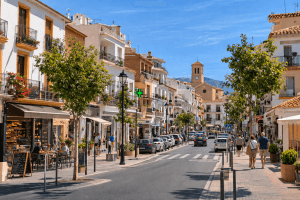
A urban core is a recognized population center with basic amenities such as:
- Water
- Sewer
- Street lighting
- Phone and utilities
- A separate municipality or administrative structure
Dwellings in an urban center are generally considered standard risk. Accessibility is good, emergency services are nearby, and social control is greater.
For insurers, this means, statistically speaking:
- Faster response to fire or water damage
- Less chance of long-term, unnoticed burglary
- Better infrastructure
What is an “urbanización”?
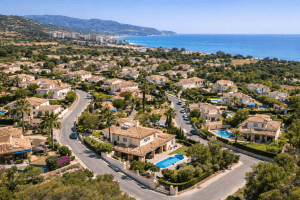
A urbanization is a residential area outside the village center, often with:
- Shared infrastructure
- Own driveways
- Sometimes shared amenities (swimming pool, garden, security)
At a gated community Is it a gated community with:
- Access control
- Fencing
- Sometimes permanent monitoring
This can lower the risk of burglary, but legally it remains a location outside the classic village center.
For insurers, consideration is given to:
- Access control
- Occupancy rate (many second homes?)
- Proximity of emergency services
What is a “despoblado”?
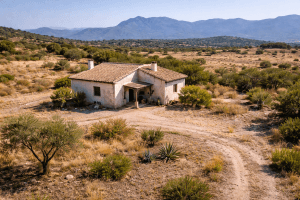
A uninhabited refers to a dwelling or area:
- In a rural area
- Without full utilities
- Without a clear residential core
- With limited social control
This type of location is explicitly considered high-risk in Spain.
Why?
- Emergency services intervention
- Greater chance of long-term vacancy
- Less social control
- More exposure to the elements
This is an important point to consider for second homes in rural areas.
Does this affect your home insurance in Spain and your premium or coverage?
The location can affect:
- Premium calculation
- The required security measures
- Maximum coverage for theft
- Conditions during vacancy
In rural areas, for example, it can be expected that:
- The access door is a certified security door
- Are there bars or roller shutters present
- An alarm system has been installed
If this security is not present while it was contractually agreed upon, in case of damage the Rule of proportionality are applied.
Specific risks in rural areas
In practice, we more often see in depopulated or rural areas:
- Burglary during a long absence
- Water damage discovered late
- Damage from storm or heavy rainfall
- Problems with sewage or septic systems
Additionally, administrative procedures in rural municipalities can be slower, which can affect recovery or expertise trajectories.
Difference with Belgium and the Netherlands
In Belgium and the Netherlands, the exact location within a village or rural area typically plays a less explicit role in the policy conditions.
In Spain, on the other hand, the location is often concretely named in the risk analysis.
The combination of:
- Climate
- Build quality
- Distance to emergency services
- Vacant second homes
… makes the geographical location weigh more heavily.
When does this become truly relevant?
The location of your home becomes especially important when:
- Theft (robbery)
- Long-term vacancy
- Water damage in absence
- Rural areas
In case of damage, the insurer will not only look at the event itself, but also at the risk context in which it occurred.
Summary
At a Home insurance in Spain is the location of your home more than a geographical detail:
- Urban core is considered a standard risk
- Urbanization can lower or increase risk, depending on security.
- Despoblado is seen as a high risk
- Security measures weigh heavier in rural areas
- Vacancy plays a stronger role outside residential areas.
In conclusion
Many Dutch owners consciously choose peace and space outside the village center. That is perfectly understandable.
But within a home insurance policy in Spain, location also means risk classification. Not to discourage you, but to correctly assess the risk.
Who understands terms like urbanization and uninhabited can be legally interpreted, can better assess which preventive measures are sensible and how the home can be optimally protected.
That insight prevents surprises when it really matters.