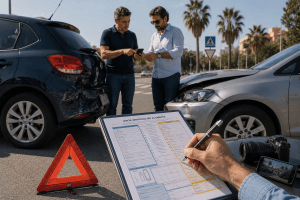
Damage is always inconvenient.
Whether it's water damage in your home, a car collision or some other problem that requires you to call on your insurance, no one schedules it.
Yet many expats find that it is not the damage itself that is most difficult, but the process around it.
What happens first? Who should you contact? When will you hear back? And why does everything seem to move so slowly sometimes?
In this article, we take you not through policy terms, but through the actual course of a claim in Spain, as people experience it.
An injury rarely begins with clarity. It usually begins with doubt.
- Is this serious enough to report?
- Should I do something right away?
- Is this my responsibility or someone else's?
Many expats at this stage try to judge for themselves first or wait “until it is clearer.” This is human, but not always wise.
In Spain the moment of notification more important than many people think, not because everything must be solved immediately, but because that's where the process begins.
The tax return: easier than expected, but crucial
The claim declaration itself is often less complex than expected. What it does require is clarity:
What happened? When? Where? Who was involved?
It is not about the perfect story, but about a correct first sketch. In Spain, a claim is later further investigated, completed and adjusted. The declaration is the starting point, not a final report.
Those who wait too long or remain too vague find that this causes delays or discussions later.
The expert: an important moment
After the report is filed, an expert often visits.
For many expats, this is exciting because they don't really know what to expect.
Important to understand:
- the expert is not a counterparty
- but also not a personal advocate
- he or she observes, notes and reports
In Spain, expertise plays a central part in further processing. What is determined here forms the basis for decisions about recovery, compensation or follow-up steps.
Therefore, make sure:
- the damage is clearly visible
- relevant information is available
- no assumptions are made
Waiting time: where impatience meets reality
One of the biggest frustrations with damage in Spain is the waiting time.
Not everything happens immediately, even if the damage seems urgent.
There are several reasons for this:
- multiple parties are involved
- approvals are phased
- repairs must be scheduled
For those used to speed, this sometimes feels like standing still.
In reality, the file does move, but not always visible.
Those who understand that claims processing here is step-by-step rather than simultaneous often experience less stress.
Repair or reimbursement: not always a free choice
Many people assume that after a claim, they can choose for themselves: have it repaired or receive compensation.
In Spain, that choice depends on several factors:
- the type of damage
- the coverage
- the arrangements with repairers
- the expert's opinion
This does not mean that you have no say, but it does mean that the pathway is often predetermined. This differs from what many expats are used to from their home countries.
When things get complicated
Most claims proceed without major problems. But some situations create complexity:
- lack of clarity about responsibility
- multiple insurances involved
- damage that develops over time
- differences in interpretation
In these cases, the distinction between:
- what happened
- and who is responsible for what
suddenly crucial.
Many expats then find that the system does not work against them, but neither does it automatically work for them. It requires follow-up, patience and sometimes clarification.
What people often say afterwards
When a damage is completed, we hear similar reactions:
- “I didn't know it went that way.”
- “I should have reported earlier.”
- “It took longer than expected, but it worked out.”
These are not exceptions. They show that knowledge of the process can prevent much distress, even when the damage itself cannot be avoided.
Why understanding the process gives peace of mind
Damage is never pleasant. But knowing what to expect makes a big difference.
Who understands:
- That damage occurs in stages
- That wait times are part of the system
- That clarity is more important than speed
experiences less uncertainty and can deal more realistically with the course.
Summary
An injury case in Spain does not happen chaotically, but it does happen differently than many expats expect:
- it starts with timely notification
- expertise plays a central role
- waiting times are normal, not exceptional
- choices around repair or reimbursement depend on the situation
- clarity and follow-up make the difference
Those who know this process are stronger when it matters.